Outdated Data = Missed Recoveries: Rethinking Skip Tracing in Debt Collection

Stop Chasing Old Records Find the Right Customer Author Ekta Singh Published on October 7, 2026 Skip tracing in debt collection is often treated as a last resort. Banks begin tracing only after calls go unanswered, messages bounce, and the account moves deeper into delinquency. But customers rarely become unreachable overnight. Their contactability usually declines over time: a number becomes inactive, an address changes, communication repeatedly fails, or the customer stops responding through previously active channels. If banks detect these changes early, skip tracing can become more than a search for missing customers. It can help verify current contact information, improve right party contact, and prevent collection teams from repeatedly acting on outdated records. Why Customer Contact Information Becomes Unreliable A customer’s record may appear complete and still be unusable. Here’s when contactability declines: A customer changes their primary number or SIM A previously active number is disconnected or reassigned The customer relocates without updating the bank An email address becomes inactive Repeated delivery failures are not investigated Contact information remains unchanged across a long account lifecycle Searching for additional numbers or addresses does not solve the problem. Before using newly available information, the bank must determine: 1 How recently was it verified? 2 Can it be reliably linked to the customer? 3 Is it likely to improve the chances of contact? Without these checks, skip tracing tools may increase unsuccessful outreach or direct collection activity towards the wrong person. The challenge is not simply finding more data. It is identifying information reliable enough to guide the next collection action. How TrueDigi Strengthens Skip Tracing in Debt Collection for Banks TrueDigi helps banks answer two practical questions: Which number is currently relevant, and where should the next collection effort be directed? TruNumber: Retrieve the Mobile Number in Use TruNumber is a consent-driven feature that retrieves the mobile number currently being used on the customer’s registered device, that is, the device on which the bank’s app is active. It helps banks: Establish right party contact using the in-use mobile number Reduce time and resources spent on traditional calling and collection methods Improve collection-agent efficiency and productivity TruLocate: Find the Device’s Current or Last Known Location TruLocate uses consent-based, real-time GPS data to provide the device’s precise current or last-known location directly to the collection team. It helps banks: Locate devices without searching across a broad area Provide field officers with a direct route to the available location Reduce the time, effort, and cost involved in field collections Together, TruNumber and TruLocate make skip tracing: 100% accurate 100% compliant 70% more cost-efficient For banks, this means fewer unsuccessful calls, less time spent locating customers, better-directed field visits, and more collection effort reaching the intended customer. [Also Read: Debt Collection in Banking: Why Digital Notices Are Becoming Critical] Conclusion: Make Skip Tracing an Earlier Debt Collection Capability Effective skip tracing is not about finding the largest volume of customer data. It is about recognising when contact information is becoming unreliable, evaluating the strongest available information, and choosing the next action most likely to reach the intended customer. When integrated into the digital debt collection process, TrueDigi’s skip tracing tools can move from a late-stage search exercise to an ongoing contact-intelligence capability, helping banks improve right party contact while using collection resources more effectively. Smart pick for you… All Posts October 7, 2026 Outdated Data = Missed Recoveries: Rethinking Skip Tracing in Debt Collection September 25, 2026 Do Your Debt Collection Calls Have Low Engagement Rates? September 8, 2026 Is Your Debt Recovery Rate Low Despite Sending Regular Reminders? Follow Us On LinkedIn About TrueDigi TrueDigi is Datacultr’s AI-powered, user-trusted, direct to device customer engagement and debt recovery platform for banks and lenders. Embedded within the bank’s mobile app, it enables end-to-end journeys across collections and customer lifecycle use cases with 100% contactability, actionability, and real-time measurability. Improve right party contact and collection efficiency with consent-based contact and location intelligence. Book a Demo People also ask Still have questions? Can’t find answers to your questions? Contact Us How does skip tracing support debt collection? Skip tracing helps identify the mobile number currently being used on the customer’s registered device and the current or last known location of the device. Banks can use these insights to improve digital outreach, verify customer details, or plan field visits more effectively. Should every unsuccessful contact attempt trigger skip tracing? No. A single unanswered call or message does not necessarily indicate a contactability problem. Banks should define triggers based on repeated failures, invalid-number responses, undelivered communications, contact-record age, and the customer’s previous response behaviour. How should banks prioritise accounts for skip tracing? Banks can prioritise accounts based on exposure, delinquency stage, contact-failure history, record recency, previous engagement, available alternative information, and the likely cost of further collection activity. Skip tracing helps identify the mobile number currently being used on the customer’s registered device and the current or last known location of the device. Banks can use these insights to improve digital outreach, verify customer details, or plan field visits more effectively. No. A single unanswered call or message does not necessarily indicate a contactability problem. Banks should define triggers based on repeated failures, invalid-number responses, undelivered communications, contact-record age, and the customer’s previous response behaviour. Banks can prioritise accounts based on exposure, delinquency stage, contact-failure history, record recency, previous engagement, available alternative information, and the likely cost of further collection activity.
Do Your Debt Collection Calls Have Low Engagement Rates?

Do Your Debt Collection Calls Have Low Engagement Rates? More Calls. Still Low Engagement? Fix the Real Gap. Author Ekta Singh Published on September 25, 2026 Do borrowers answer your debt collection calls? Does your team respond to low engagement by increasing call attempts? More calls will not solve the problem if borrowers do not recognise the caller or the conversation gives them no reason to respond. A May 2026 report found that 66% of unknown calls in India were identified as spam or fraud. When two out of every three unfamiliar calls are classified this way, even genuine collection calls may be ignored before borrowers know which bank is contacting them. Why Do Debt Collection Calls Have Such Low Engagement Rates? Debt collection calls often have low engagement because borrowers do not recognise the caller, calls reach outdated numbers, or repeated attempts resemble spam. Even answered calls may fail when they repeat old information, ignore previous interactions, or provide no clear next step. Several factors can lead to this breakdown: 1 No recognisable caller identity: When the borrower sees an unknown number instead of the bank’s name, hesitation begins before the conversation does. 2 Outdated or reassigned numbers: Borrowers may change their phone numbers or SIMs while bank records remain unchanged. Repeatedly calling the same number increases attempts without improving right party contact. 3 Poor timing: Calls made while borrowers are working, commuting or otherwise unavailable may repeatedly go unanswered. 4 Repetitive communication: If every call repeats information already shared through SMS or email, it gives the borrower no new reason to listen or act. 5 No clear next step: Even an answered call may not lead to action if it ends without guiding the borrower towards payment, a commitment or another suitable resolution. Call performance should therefore be measured beyond attempts and pickups: Calls Attempted → Right Party Reached → Borrower Engaged → Commitment Made → Commitment Fulfilled A drop between two stages shows where the problem lies. Low right party contact points to a reach problem. Strong contact but weak engagement may indicate poor timing, low trust, or an irrelevant message. Unfulfilled commitments suggest that the bank’s follow-up treatment needs attention. [Also Read: Customer Engagement Strategies for Banking Leaders] How Does TrueDigi Improve Debt Collection Call Engagement? TruCall by TrueDigi gives banks a branded digital voice channel that reaches the borrower’s registered device without dialling a mobile number. This reduces dependence on phone records that may be outdated or reassigned and supports stronger right party contact. Banks can use recorded audio or text-to-speech for consistent voice messages and measure delivery and subsequent borrower action. This makes each interaction recognisable and measurable rather than another unexplained call attempt. 3× higher pickup rates 41% higher customer action 70% lower operational costs What Better Debt Collection Call Engagement Looks Like Effective collection calls should do more than connect. They should reach the intended borrower, build on previous interactions, and lead to a defined next action. By managing collection calls around these outcomes, banks can reduce unproductive attempts, focus agents on cases requiring human support, and move more borrowers towards resolution. Smart pick for you… All Posts September 8, 2026 Is Your Debt Recovery Rate Low Despite Sending Regular Reminders? August 20, 2026 More Outreach. Same Losses? Customer Engagement Tools for Better Debt Collection July 27, 2026 Right Party Contact (RPC): Higher Collections Start With the Right Customer Follow Us On LinkedIn About TrueDigi TrueDigi is Datacultr’s AI-powered, user-trusted, direct to device customer engagement and debt recovery platform for banks and lenders. Embedded within the bank’s mobile app, it enables end-to-end journeys across collections and customer lifecycle use cases with 100% contactability, actionability, and real-time measurability. See how TruCall can help your bank improve collection call engagement. Book a Demo People also ask Still have questions? Can’t find answers to your questions? Contact Us How Often Should Banks Make Collection Calls? There is no single suitable frequency for every borrower. Banks should consider delinquency stage, previous responses, preferred contact times, consent, and applicable regulations. Repeating collection calls without changing their timing or purpose can further reduce engagement. How Can Banks Maintain Right Party Contact When a Phone Number Changes? Banks can use device-based communication that does not depend on the borrower’s current mobile number. TruCall by TrueDigi delivers digital voice communication directly to the borrower’s registered device, helping the bank maintain right party contact even when telecom records change. What Is a Good Engagement Rate for Debt Collection Calls? There is no single benchmark that applies to every bank. Engagement varies by borrower segment, delinquency stage, portfolio, and call purpose. Banks should establish a baseline for right party contact, borrower response, commitments made, and commitments fulfilled, then compare performance across similar accounts and campaigns. There is no single suitable frequency for every borrower. Banks should consider delinquency stage, previous responses, preferred contact times, consent, and applicable regulations. Repeating collection calls without changing their timing or purpose can further reduce engagement. Banks can use device-based communication that does not depend on the borrower’s current mobile number. TruCall by TrueDigi delivers digital voice communication directly to the borrower’s registered device, helping the bank maintain right party contact even when telecom records change. There is no single benchmark that applies to every bank. Engagement varies by borrower segment, delinquency stage, portfolio, and call purpose. Banks should establish a baseline for right party contact, borrower response, commitments made, and commitments fulfilled, then compare performance across similar accounts and campaigns.
Is Your Debt Recovery Rate Low Despite Sending Regular Reminders?
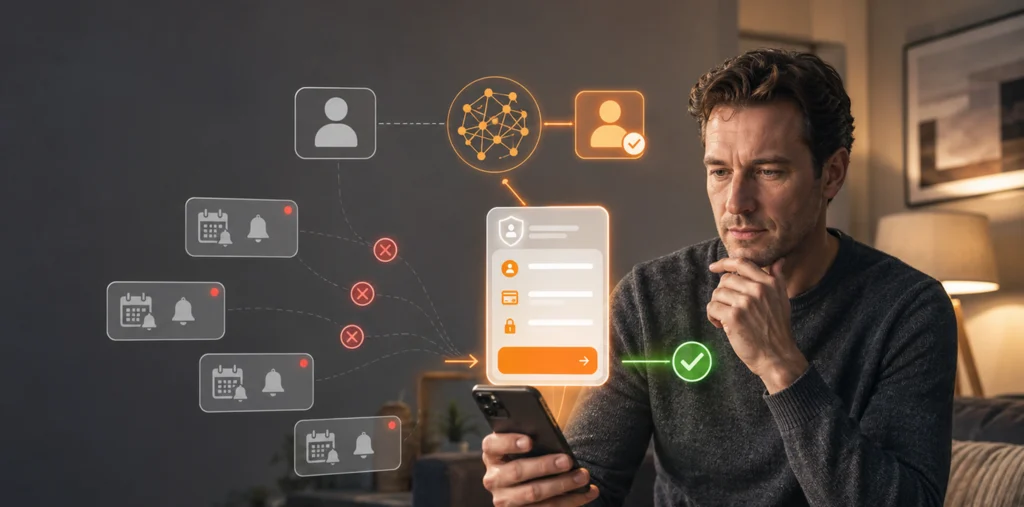
Is Your Debt Recovery Rate Low Despite Sending Regular Reminders? Payment Due. Response Missing. Make Every Message Actionable. Author Ekta Singh Published on September 7, 2026 How many reminders does it take to improve the debt recovery rate after a missed payment? One? Three? Five? Ten? A higher debt recovery rate does not necessarily require more reminders. It requires communication that reaches the right borrower, captures attention, reflects their circumstances, and makes repayment easy. A 2026 study found that 86% of calls from unknown numbers go unanswered. This reveals a fundamental problem for banks: a repayment reminder cannot influence borrower action if the communication is ignored before the bank can even identify itself. Even successful delivery does not mean progress. Banks must measure what happens throughout the recovery journey: Sent → Delivered → Viewed → Acted On → Payment Completed The real question, therefore, is not simply, “How regularly are reminders being sent?” Banks must ask: Did the reminder reach the right borrower through the right medium, and what happened next? The point where borrowers leave this journey reveals what needs to change. What Keeps the Debt Recovery Rate Low and How Can Banks Improve It? A debt recovery rate can remain low because sending a reminder does not guarantee that the right borrower receives, trusts, notices, or acts on it. Poor timing, outdated contact details, generic messages, and unclear payment steps can turn reminders into background noise. 01 Poor Right Party Contact Phone numbers, email addresses, and customer records change. A reminder may be marked as delivered without reaching the person responsible for the account. Improving right party contact requires banks to know whether communication reached the intended borrower, not simply whether a channel accepted the message. That’s where TrueDigi helps. It delivers repayment communication through the bank’s app on the customer’s device, helping banks reach the right customer before moving forward with recovery. 02 Communication Looks Like Spam or Fraud Would you answer an unfamiliar call or open an unexpected payment link? Even genuine communication may be ignored when borrowers cannot clearly identify the bank. Repeated messages through channels that look like spam or fraud may increase contact attempts without improving the debt recovery rate. Therefore, banks need a way to make urgent repayment communication easy to identify and trust. With TruAlert by TrueDigi, they can deliver these messages through their own app on the intended device. 03 Communication Does Not Match Borrower Preferences A forgotten due date, failed payment, and repeated non-payment require different responses. Borrowers may also respond differently depending on the language, communication format, and time of contact. To address this, TrueDigi uses AI to communicate in the borrower’s preferred language and channel at the right time. Messages and follow-ups can be tailored to the borrower’s previous response and collection stage, making communication more relevant. This helps banks address the engagement gaps that can keep the debt recovery rate low. [Also Read: TrueDigi by Datacultr: Turning Low Efficiency into High Collection Performance] 04 Reminder Does Not Provide a Clear Payment Action “Your payment is overdue” states the problem but does not help the borrower resolve it. A recovery-focused reminder should let the borrower: Check the amount due and payment deadline Pay securely through an authenticated payment link Report a payment issue or request support With TruEngage by TrueDigi, borrowers can review payment details and take the required action directly from the message. This turns the reminder into a clear next step instead of another general warning. 05 Borrowers Cannot Record a Promise to Pay Some borrowers intend to pay but cannot complete the payment immediately. Repeated reminders do not capture that intent or tell the bank when payment can be expected. In such cases, TruPromise by TrueDigi allows borrowers to select and confirm a promise-to-pay date and record their commitment digitally. Banks can then follow up based on whether the borrower makes or misses the promised payment. Smart pick for you… All Posts August 20, 2026 More Outreach. Same Losses? Customer Engagement Tools for Better Debt Collection July 27, 2026 Right Party Contact (RPC): Higher Collections Start With the Right Customer July 15, 2026 Debt Collection in Banking: Why Digital Notices Are Becoming Critical Follow Us On LinkedIn Improve the Debt Recovery Rate by Making Every Reminder Actionable Improving the debt recovery rate begins with asking a simple question before sending another reminder: What should this borrower be able to do after receiving it? If the answer is unclear, the reminder is incomplete. Every communication should create a measurable borrower response that helps the bank determine the next appropriate collection action. About TrueDigi TrueDigi is Datacultr’s AI-powered, user-trusted, direct to device customer engagement and debt recovery platform for banks and lenders. Embedded within the bank’s mobile app, it enables end-to-end journeys across collections and customer lifecycle use cases with 100% contactability, actionability, and real-time measurability. Turn every repayment reminder into a clear, measurable action with TrueDigi. Book a Demo People also ask Still have questions? Can’t find answers to your questions? Contact Us What Makes TrueDigi One of the Top Rated AI-Powered Debt Recovery Services? When comparing top rated AI-powered debt recovery services, banks should look beyond automated messaging. Platforms like TrueDigi offer initial reminders, interactive repayment journeys, digital promises to pay, voice communication, formal notices, and contact discovery as an account progresses through collections. How Often Should Debt Recovery Reminders Be Sent? There is no universal frequency. Banks should base timing on the repayment stage, previous responses, borrower behaviour, and applicable regulations. Repeating an ineffective reminder more frequently is unlikely to improve recovery rates. Which Metrics Should Be Tracked Alongside Recovery Rates? Banks should track right party contact, message views, borrower responses, payment actions, promises to pay, fulfilled promises, completed payments, time to resolution, and collection cost. Together, these metrics show where the debt recovery journey is working or breaking. Why Do Some Companies Still Struggle to Improve Their Debt Recovery Rate? Many companies focus only on the final recovery rate and
More Outreach. Same Losses? Customer Engagement Tools for Better Debt Collection

More Outreach. Same Losses? Customer Engagement Tools for Better Debt Collection Delivery Is Not Enough Turn Communication into Action Author Ekta Singh Published on August 20, 2026 Customer engagement tools have become central to how banks manage collection losses. Yet sending more reminders through more channels does not guarantee repayment. Collection losses often begin long before an account becomes delinquent, when communication fails to reach the right customer, appears untrustworthy, or makes taking the next step difficult. Banks can reduce these losses by closing four gaps in the collection journey: Reach, Trust, Action, and Treatment. Every communication must reach the intended customer, be recognisably from the bank, provide a clear next step, and reflect the customer’s situation. Four Gaps That Weaken Digital Debt Collection The Reach Gap: A delivered message may not reach the person responsible for the account. Numbers change, SIM cards are replaced, calls go unanswered, and shared devices complicate right-party contact. Banks must measure verified customer contact, not simply delivery. The Trust Gap: Even when communication reaches the right customer, an unknown call, generic message, or shortened payment link may appear suspicious. Customers need to recognise the bank and understand the purpose of the communication before they engage. The Action Gap: Many reminders explain the overdue payment but leave customers to find the solution. Additional apps, logins, and payment steps increase the likelihood of abandonment. Customer engagement tools should connect the message directly to actions such as Pay Now or making a promise to pay. The Treatment Gap: A forgotten due date, delayed salary, financial hardship, and deliberate avoidance require different responses. Applying the same message, frequency, and escalation to every customer increases effort and can damage the relationship. [Also Read: AI Customer Engagement: What Real Customer Outreach Must Look Like in 2026] Why More Outreach Alone Does Not Close These Gaps Closing these gaps requires more than adding calls, SMS, email, WhatsApp, and push notifications to the collection journey. Banks must improve the quality of each customer interaction, not simply increase the volume of communication. This is especially important as genuine bank communication competes with fraudulent calls, fake payment links, misleading security alerts, and, of course, other banks and utility service providers. In 2025, US consumers reported losing $3.5 billion to imposter scams. Singapore recorded S$242.9 million in government-official impersonation scam losses, while consumers in the UK lost £92.4 million to impersonation scams, including £55.5 million to criminals posing as bank employees or police officers. In this environment, repeated outreach through external channels may increase suspicion rather than encourage a response. Banks need communication that customers can recognise, trust, and act on easily. [Also Read: Customer Engagement Strategies for Banking Leaders] How TrueDigi Enables Trusted Customer Engagement TrueDigi gives banks a direct to device engagement layer within their existing mobile app. Through a lightweight SDK, banks can deliver secure, user-trusted, contextual communication directly on the customer’s device. This reduces dependence on external channels and gives the bank greater control over how a message appears, when it is shown, and what the customer can do next. TrueDigi supports bank-branded alerts, full-screen messages, authenticated calls with visible context, promise-to-pay journeys, payment actions, educational content, and digital notices. Together, these formats support communication throughout the collection journey. TrueDigi connects the bank’s collection strategy, customer messaging, and required action within one measurable journey. It works alongside existing collection systems, loan management systems, CRMs, and communication channels through a Zero-PII approach Smart pick for you… All Posts August 20, 2026 More Outreach. Same Losses? Customer Engagement Tools for Better Debt Collection July 27, 2026 Right Party Contact (RPC): Higher Collections Start With the Right Customer July 15, 2026 Debt Collection in Banking: Why Digital Notices Are Becoming Critical Follow Us On LinkedIn The Complete Customer Experience Solution TrueDigi enables banks to use different communication formats and actions based on the customer’s situation and collection stage: 1. TruVideo helps customers understand their repayment details and available payment options through educational video messages. 2. As the due date approaches, TruCall delivers a bank-branded voice call to help customers prepare for the upcoming payment. 3. Closer to the due date, TruEngage displays an on-screen reminder with a direct payment option, making it easier for the customer to act immediately. 4. If the payment becomes overdue, TruPromise allows the customer to pay immediately or select a suitable promise-to-pay date. 5. If the account reaches the escalation stage, TruNotice delivers a legally compliant digital notice with proof of delivery. If the account reaches the escalation stage, TruNotice delivers a legally compliant digital notice with proof of delivery. This helps protect the customer experience while directing collection resources towards accounts requiring greater intervention. Customer Engagement Tools Must Deliver Collection Outcomes Delivery, open, and click rates show communication activity, but not whether recovery has improved. Banks should focus on right-party contact, engagement-to-payment conversion, time to payment, promise-to-pay fulfilment, early-stage cure rates, and cost per resolved account. These metrics help identify the underlying gap. High delivery with low engagement may indicate weak trust, while strong engagement with low payment conversion may reveal friction in the payment journey. Customer experience and collection performance are not competing priorities. When TrueDigi’s customer engagement tools make communication recognisable, treatment appropriate, and action easier, banks can reduce collection losses while protecting the customer relationship. About TrueDigi TrueDigi is Datacultr’s AI-powered, user-trusted, direct to device customer engagement and debt recovery platform for banks and lenders. Embedded within the bank’s mobile app, it enables end-to-end journeys across collections and customer lifecycle use cases with 100% contactability, actionability, and real-time measurability. Turn every collection communication into a trusted, measurable action. Book a Demo People also ask Still have questions? Can’t find answers to your questions? Contact Us What does a good and effective customer engagement tool for banks include? The best customer engagement tool for banks should include capabilities that improve right-party contact, establish trust, enable customers to act within the same journey, support differentiated treatments, and connect engagement with actual payment outcomes. How can
Right Party Contact (RPC): Higher Collections Start With the Right Customer

Right Party Contact (RPC): Higher Collections Start With the Right Customer In collections, every recovery strategy depends on one thing: reaching the right customer. Higher RPC. Better Collections. Stop Chasing. Start Reaching. Author Ekta Singh Published on July 27, 2026 Banks may use AI to optimise timing, automate reminders, personalise messages, and prioritise high-risk accounts. But if the communication does not reach the correct borrower, the strategy fails before it can create any outcome. Low RPC rate directly affects collection campaign performance, recovery rates, and the efficiency of the overall debt recovery process. That’s why improving Right Party Contact, or RPC, becomes critical. Let’s look at why right party contact rates are falling and how to increase right party contacts with TrueDigi’s certain, direct-to-device collection approach. Why RPC Remains Low in Debt Collection The industry has accepted a low bar for customer contact for too long. The average RPC rate is around 26%, while 23% of call centers have an RPC rate below 20%. This means a large part of outreach is still not reaching the right borrower. Several factors continue to pull RPC rates down: 1 Outdated or incorrect mobile numbers that make collection teams chase numbers instead of borrowers 2 Unknown calls are getting ignored because customers are more cautious about spam, fraud, and unverified numbers 3 Increased use of call blockers that prevent even genuine collection calls from connecting 4 Borrowers are becoming harder to trace as delinquency progresses, and traditional contact details stop working 5 SMS, email, and call fatigue that reduces response, even when the message is relevant So even when banks increase outreach volume, the right party contact rate may remain low because the underlying contact path is still uncertain. Why AI-Led Collections Still Need the Right Party Contact AI can improve collections in many ways. It can help banks decide when to contact a customer, what message to send, which account to prioritise, and what repayment path to recommend. But the benefits are barely incremental because AI does not guarantee RPC. This is why RPC must come before optimisation. AI can make collections smarter, but RPC makes them reachable. For banks, the goal is not to choose between AI and RPC. The goal is to build a collection system where the right customer is reached first, and AI then improves timing, context, and next-best action. How TrueDigi Helps Increase Right Party Contacts Most collection systems try to improve RPC by improving outreach: more calls, better timing, repeated reminders, or higher campaign frequency. TrueDigi solves it at the contact layer. Built into the bank’s own mobile app through a lightweight SDK, TrueDigi creates a secure direct-to-device engagement layer that does not depend on phone numbers, telecom calling, SMS delivery, unknown caller pickup, or changing borrower locations. This gives banks a verified path to the customer’s device, helping them move from uncertain outreach to certain reachability. With TrueDigi, collection communication can be delivered directly to the intended customer with 100% contactability, 100% deliverability, 100% actionability, and 100% measurability. Smart pick for you… All Posts July 27, 2026 Right Party Contact (RPC): Higher Collections Start With the Right Customer July 15, 2026 Debt Collection in Banking: Why Digital Notices Are Becoming Critical June 26, 2026 Omnichannel Marketing Challenges and Solutions for Banks Follow Us On LinkedIn TrueDigi’s Tools to Boost Right Party Engagement 1 TruCall (Device-Level Voice Communication): TruCall delivers bank-branded voice calls directly on the customer’s device, without depending on telecom calling infrastructure. It helps banks reduce RPC failures caused by number changes, unanswered unknown calls, call blocking, or low pickup rates. 2 TruNumber (Active Mobile Number Intelligence): TruNumber helps identify the customer’s active mobile number, reducing failed attempts caused by outdated, incorrect, or inactive contact details. This gives collection teams a stronger contact base before follow-ups begin. 3 TruLocate (Consent-Based Location Intelligence): TruLocate supports consent-based location intelligence for hard-to-reach borrowers. It is especially useful in skip tracing and late-stage collections, where traditional contact details may no longer be enough. 4 Direct-to-Device Messages (Secure Customer Reachability): TrueDigi allows banks to send secure text reminders, full-screen alerts, payment nudges, and escalation messages directly to the intended customer device. This improves visibility, trust, and actionability across the collection journey. Together, these capabilities help banks solve the real RPC problem: not just whether a call was made or a message was sent, but whether the right customer was reached through a contact path the bank can trust, measure, and act on. [Also Read: TrueDigi by Datacultr: Turning Low Efficiency into High Collection Performance] Set a Higher Standard for the Right Party Contact with Us The next phase of debt collection will not be won by teams that simply increase outreach volume. It will be shaped by banks that start building stronger ways to reach the right borrower on the first attempt. That shift matters because every collection strategy depends on the same foundation: the ability to reach the right customer. For banks, this means RPC can no longer sit only inside contact-centre reporting. It must become a core measure of collection readiness, customer trust, and recovery performance. With TrueDigi, that shift becomes possible. About TrueDigi TrueDigi is Datacultr’s AI-powered, user-trusted, direct to device customer engagement and debt recovery platform for banks and lenders. Embedded within the bank’s mobile app, it enables end-to-end journeys across collections and customer lifecycle use cases with 100% contactability, actionability, and real-time measurability. If low RPC is limiting your collection outcomes, it’s time to fix the contact layer first. Book a Demo People also ask Still have questions? Can’t find answers to your questions? Contact Us What is the risk of scaling debt collection efforts without improving RPC? Scaling debt collection efforts without improving RPC often increases effort without improving recovery at the same pace. More calls, reminders, agents, or automated campaigns may lift activity, but if the right borrower is still not being reached, banks risk scaling operational inefficiency instead of collection performance. Why should banks track RPC rate separately from delivery
Debt Collection in Banking: Why Digital Notices Are Becoming Critical
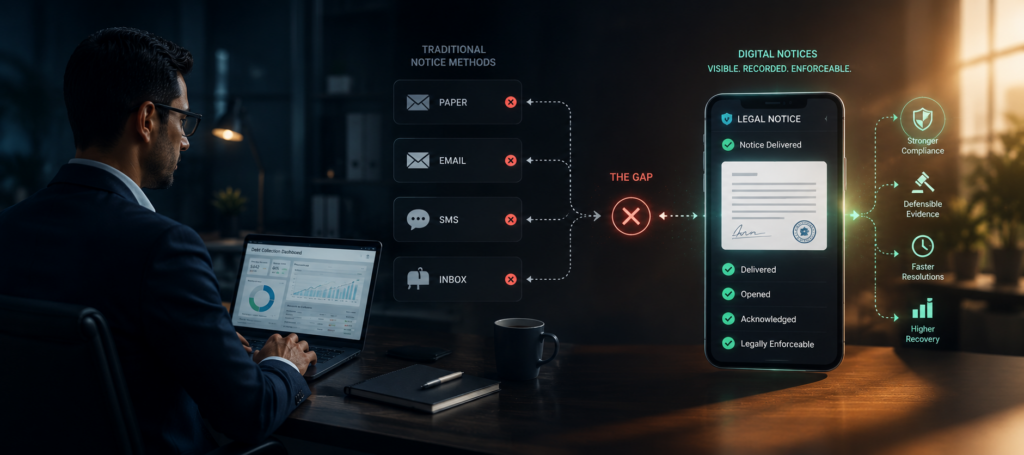
Debt Collection in Banking: Why Digital Notices Are Becoming Critical Debt collection is moving towards digital. Legal notices are not. Legal Notices, Digitally Delivered Escalation With Proof Author Ekta Singh Published on July 15, 2026 Banks are digitising borrower engagement, collection journeys, repayment nudges, and recovery workflows. But when an overdue account reaches the legal stage, many lenders still depend on paper notices, emails, SMS, or inbox-based channels. These channels may confirm that a notice was dispatched or delivered, but they do not guarantee 100% right-party contact, borrower visibility, or acknowledgement. And that is where the gap begins. Because at the legal escalation stage, sending a notice is not enough. Banks need to know that the notice reached the borrower, was opened, was acknowledged, and can be defended if questioned later. This is why digital notices are becoming critical in debt collection. Not as another communication channel, but as a stronger way to make legal notice delivery visible, recorded, and enforceable within the recovery journey. The Legal Notice Gap in Digital Debt Collection When defaults rise and more accounts move into escalation, the notice process becomes a direct part of recovery performance. But paper notices cost more, take longer, and create repeated operational effort. Email and inbox-based notices may be easier to send, but they do not always confirm borrower visibility. Messaging channels can be ignored, filtered, or treated as routine communication. None of this works well when the legal system needs proof. If the borrower does not see the notice in time, the response is delayed. If there is no acknowledgement, escalation becomes harder to defend. If the process depends on manual follow-ups, cost rises while certainty remains low. This directly affects recovery outcomes. At this stage, the concern is no longer just borrower outreach. It is whether the bank can move the case forward with enough visibility, evidence, and control. TruNotice by TrueDigi: Digital Legal Notices Built for Debt Collection TruNotice by TrueDigi addresses the core limitations of traditional legal notice delivery: uncertain reach, weak traceability, high cost, and low efficiency. It is a secure, bank-branded digital legal notice solution that delivers notices directly to the borrower’s active device. The notice is designed to be clear, visible, and action-led, with a contextual CTA that helps borrowers understand the next step immediately. This shifts legal notice delivery from an uncertain communication attempt to a digitally controlled escalation workflow. TruNotice delivers: 01 60% Increase in Recovery Rate: Borrowers responded faster when notices were delivered clearly and directly on-device. 02 Around 80% Lower Cost: Digital legal notice delivery reduced printing, courier, postage, and repeat-attempt costs. 03 100% Read Receipts: Every opened digital legal notice generated time-stamped proof that the borrower saw it. 04 100% Acknowledgement: Borrower acknowledgement created a stronger record for internal review, escalation, and next action. 05 2.4X Increase in Verified Delivery Rate: More notices successfully reached active borrower devices compared to paper and inbox-based channels. For banks building stronger digital debt collection solutions, TruNotice turns legal notice delivery from a slow, uncertain process into a branded, measurable, and defensible escalation workflow. [Also Read: The Future of Digital Debt Recovery in 2026] Smart pick for you… All Posts July 27, 2026 Right Party Contact (RPC): Higher Collections Start With the Right Customer July 15, 2026 Debt Collection in Banking: Why Digital Notices Are Becoming Critical June 26, 2026 Omnichannel Marketing Challenges and Solutions for Banks Follow Us On LinkedIn Building a Stronger Digital Strategy in Debt Collection with TrueDigi TruNotice works as a user-trusted escalation layer within TrueDigi’s larger direct-to-device debt collection platform. Before an account reaches legal escalation, TrueDigi helps banks engage borrowers through direct-to-device reminders, alerts, TruCall, TruPromise, TruTrace, and other capabilities. TruCall supports branded voice communication directly on the borrower’s device. TruPromise enables digital promise-to-pay journeys. TruTrace strengthens reachability through contact and location intelligence. Together, these tools help banks act earlier, before a case reaches the formal legal stage. When the borrower still does not respond, TruNotice brings the legal notice layer into the same digital strategy in debt collection, making escalation structured, recorded, and action-led. This is how TrueDigi’s digital debt collection solutions help banks move from fragmented outreach to a connected recovery journey: engage early, ease the repayment process, strengthen borrower visibility, and escalate with proof when required. Conclusion For banks, the real question is no longer whether debt collection should become digital. That shift has already begun. The question is whether every stage of the recovery journey is digital enough to support faster decisions, stronger records, and better outcomes. Legal notice delivery is one of the most critical stages in that journey because it sits at the point where delay becomes expensive, and uncertainty becomes risky. Bringing this stage into a controlled digital workflow helps banks strengthen not just escalations, but the overall quality of their digital strategy in debt collection. That is the direction recovery teams need to move toward: fewer gaps, clearer action, and stronger control across the full debt collection lifecycle. About TrueDigi TrueDigi is Datacultr’s AI-powered, user-trusted, direct to device customer engagement and debt recovery platform for banks and lenders. Embedded within the bank’s mobile app, it enables end-to-end journeys across collections and customer lifecycle use cases with 100% contactability, actionability, and real-time measurability. Make legal notice delivery a smarter part of your digital debt collection strategy. Book a Demo People also ask Still have questions? Can’t find answers to your questions? Contact Us Does TruNotice guarantee right-party contact for digital legal notices? TrueDigi’s TruNotice delivers digital legal notices directly to the borrower’s active device, reducing dependency on paper addresses, inboxes, or phone-number-based channels. This helps banks achieve 100% right-party contact, visibility, and acknowledgement at the escalation stage. How does TruNotice make debt collection escalation more defensible? TruNotice gives banks the audit layer that traditional notice delivery lacks. Every opened notice is recorded with read receipt, acknowledgement, and time-stamped proof, helping collections, risk, and legal teams move escalation forward with greater confidence. How does TrueDigi strengthen digital debt
Omnichannel Marketing Challenges and Solutions for Banks

Omnichannel Marketing Challenges and Solutions for Banks Beyond More Channels From Outreach to Action Author Ekta Singh Published on June 26, 2026 For years, omnichannel marketing promised banks a simple advantage: reach customers wherever they are. SMS, email, WhatsApp, push notifications, calls, and app alerts were expected to improve engagement. But for many banks, adding more channels has not created better outcomes. It has created more noise. Customers are receiving more messages than ever, yet attention and trust are harder to earn. The real challenge is not reach, its relevance, credibility, and measurable action. This raises important questions: Will the customer trust the communication? Is the bank engaging the customer at the right moment? Is the message connected to the customer’s current need? Is the bank able to measure whether the engagement led to a real business outcome? For banks, this creates a serious gap between communication and customer action. The Real Problem with Traditional Omnichannel Marketing 01 It Optimises for Delivery, Not Relevance Most omnichannel tools are built to send messages across multiple channels and optimised for delivery. But delivery alone does not create engagement. For example, a customer who opens a savings account needs a different message from someone who has missed a loan repayment. Similarly, a customer who abandons onboarding needs a clear next-step nudge, not a generic offer. This is a real gap in banking communication: one consumer study found that 54% of customers felt bank communication was not personalised enough, while 39% found it only somewhat, hardly, or not at all relevant. When banks communicate without context, the message feels generic. Over time, generic communication leads to disengagement. 02 Customer Data Remains Fragmented Banks already hold rich customer data across core banking systems, CRMs, loan systems, app behaviour, service records, and collections platforms. The problem is that these systems often do not work together in real time. As a result, marketing teams rely on broad segments and delayed insights instead of live customer context. This limits personalisation and makes campaigns feel disconnected from the customer journey. 03 Personalisation Is Mostly Surface-Level “Hi [First Name]” is not personalisation. In banking, meaningful personalisation depends on customer context: financial stage, product usage, recent actions, risk signals, and next-best need. But most banking apps are still built for transactions, not personalised communication. Even when banks have the right insights, the app often cannot turn those insights into timely, action-led messages. PYMNTS reported that 72% of consumers say personalisation influences where they bank. 04 No Real Feedback Loop Many campaigns are still measured through delivery rates, open rates, and clicks. But banks need to know more than whether a message was opened. They need to know whether the campaign led to a completed action at a customer level. This is where all app-based notification platforms fail. Did the customer finish onboarding? Did they activate the card? Did they make a repayment? Did they enrol for autopay? Without this visibility, marketing teams cannot clearly connect campaigns to business outcomes, pushing them to unnecessary third-party platforms to send SMS, calls and emails. Smart pick for you… All Posts July 27, 2026 Right Party Contact (RPC): Higher Collections Start With the Right Customer July 15, 2026 Debt Collection in Banking: Why Digital Notices Are Becoming Critical June 26, 2026 Omnichannel Marketing Challenges and Solutions for Banks Follow Us On LinkedIn How TrueDigi Changes Customer Engagement for Banks TrueDigi is not another tool that adds more channels to your communication stack. It’s a fundamentally different approach, built on context, trust, and measurable customer action. With TrueDigi, banks can achieve a 5X increase in customer engagement. It reduces data exposure by working with internal customer identifiers, without requiring banks to share customer PII with external vendors. Engagement Happens Inside Your App TrueDigi works through a lightweight SDK embedded inside your bank’s own mobile app. This means the bank can engage customers in an environment they already recognise, instead of depending only on external SMS, email, or unknown calls. This helps solve a major trust gap in banking communication. The customer does not have to wonder whether the message is genuine, spam, or fraud. The message comes through a verified bank-owned environment, which makes it easier to trust and act on. One Platform for Multiple Communication Formats TrueDigi allows banks to deliver voice, video, image, and text-based messages from a single platform. Teams can choose the right format for each use case, from onboarding guides and product education to repayment reminders, offer prompts, and legal notices. This reduces the need for separate tools across calls, videos, notifications, and message delivery, while giving banks better control, consistency, and visibility across customer engagement. Context Decides the Communication Traditional omnichannel campaigns often work on broad segments and fixed schedules. TrueDigi helps banks move to journey-based engagement. Banks can trigger messages based on customer actions, lifecycle stage, product usage, or repayment behaviour, making communication more relevant and less intrusive. [Also Read: Customer Engagement Strategies for Banking Leaders] Conclusion Traditional omnichannel asks: how do we reach more customers across more channels? TrueDigi asks: what does this customer need right now, and how do we deliver it in a way they’ll trust? That’s not a small difference. It is a shift from more outreach to better engagement. When customers receive communication that’s relevant, timely, and delivered through a channel they trust, they engage. They respond. They act. That’s what effective marketing looks like. About TrueDigi TrueDigi is Datacultr’s AI-powered, user-trusted, direct to device customer engagement and debt recovery platform for banks and lenders. Embedded within the bank’s mobile app, it enables end-to-end journeys across collections and customer lifecycle use cases with 100% contactability, actionability, and real-time measurability. Discover how TrueDigi helps banks achieve up to 5X higher customer engagement. Book a Demo Frequently Asked Questions Still have questions? Can’t find answers to your questions? Contact Us How can banks reduce drop-offs in digital customer journeys? Banks can reduce drop-offs by engaging customers at the exact point where they pause, abandon, or
Customer Engagement Strategies for Banking Leaders

Customer Engagement Strategies for Banking Leaders Smarter banking engagement Measurable business outcomes Author Ekta Singh Published on June 5, 2026 Customer engagement strategies directly influence revenue, cost, and NPL risk. Yet most banks cannot measure the impact of their engagement on business outcomes because their systems were never built for outcome visibility. Budgets are going up. Results are not keeping pace. And the question, why? is rarely asked. This blog is for banking leaders who want to get ahead of that question before it becomes a costly problem. Your Customer Relationships Are Fragmenting Quietly According to Accenture, 73% of banking customers now engage with multiple banks, and 58% bought a financial product from a new provider in the last 12 months. This is a direct revenue loss- wallet share, product revenue, and lifetime value leaving your balance sheet quietly, one small move at a time. Banks in the top 20% for customer advocacy grow revenues 2.6x faster, and hold 17% more products per customer. The difference is the ability to stay relevant and measure what actually drives revenue. The banks staying ahead have made a different infrastructure decision. The Hidden Cost of Treating Outreach as Engagement Most banks run customer engagement strategies across a fragmented mix of channels. Each owned by a different team and measured in isolation, with no single view of what is actually working. And no one can answer: Is engagement failure increasing NPLs? Are we losing revenue because we cannot reach customers at the right moment? Are we overpaying for systems that are not delivering ROI? According to McKinsey, 47% of senior decision-makers cite stack complexity as the main blocker to getting ROI from engagement tools. Gartner found organisations use only 33% of their engagement technology capabilities on average. The rest is paid for but not used. Every quarter without measurable engagement outcomes is a quarter of budget spent without evidence of return. That is a cost, control, and infrastructure problem, and it compounds over time. What Fixes This: A Different Infrastructure Approach with TrueDigi TrueDigi is an AI-powered customer engagement platform built specifically for banks and regulated lenders. It embeds directly inside the bank’s own mobile app via a lightweight SDK, turning existing infrastructure into a governed, measurable engagement system. Because engagement happens inside the bank’s app, banks get: Complete lifecycle journeys: Not isolated messages, but connected sequences that adapt based on customer behaviour and context Zero-PII architecture: Customer data never leaves the bank’s environment, which matters for compliance and for trust Real-time measurement: Visibility into what customers actually do after an engagement, not just whether a message was delivered AI-driven personalisation: Every interaction is shaped by behavioural and contextual signals, making communication relevant rather than generic TrueDigi gives banks the infrastructure to govern, measure, and improve the entire customer engagement strategy end-to-end. [Also Read: AI Powered Customer Engagement: Delivering Contextual Communication] Smart pick for you… All Posts July 27, 2026 Right Party Contact (RPC): Higher Collections Start With the Right Customer July 15, 2026 Debt Collection in Banking: Why Digital Notices Are Becoming Critical June 26, 2026 Omnichannel Marketing Challenges and Solutions for Banks Follow Us On LinkedIn The Bottom Line: Engagement Is Now a Business Infrastructure Decision Unmeasured customer engagement strategies are a business liability: in budget, in compliance exposure, and in the revenue that leaves before anyone notices. Banks building an advantage are not spending more. They are building infrastructure that gives them visibility, control, and measurable outcomes. For the banking leaders, this is not a marketing decision. It is a financial and infrastructure decision. About TrueDigi TrueDigi is Datacultr’s AI-powered, direct-to-device customer engagement and debt recovery platform for banks and lenders. Embedded within the bank’s mobile app, it enables end-to-end journeys across collections and customer lifecycle use cases with 100% contactability, actionability, and real-time measurability. This is how modern banks protect trust, comply with regulations, and future-proof engagement. Book a Demo Frequently Asked Questions Still have questions? Can’t find answers to your questions? Contact Us We are already investing in AI for customer engagement. Why are we not seeing results? When customer data sits in separate systems and engagement tools operate independently, AI cannot connect an action to a business outcome. TrueDigi solves this by embedding a unified, AI-powered engagement layer directly inside the bank’s app, giving them a complete, real-time view of what engagement is actually delivering. How do we know if our current customer engagement strategies are creating compliance risk? If there is no single audit trail across your engagement channels, you cannot prove what was communicated to a customer, when, and why. That is a regulatory exposure. TrueDigi’s governed, in-app infrastructure creates a complete, auditable record of every customer interaction, by design, not as an afterthought. At what point does engagement failure become an NPL or churn risk? Earlier than most banks realise. When a customer stops responding to repayment reminders, account updates, and product communications, the bank loses visibility into intent. TrueDigi’s real-time engagement infrastructure gives banks the ability to act while there is still time to change the outcome. When customer data sits in separate systems and engagement tools operate independently, AI cannot connect an action to a business outcome. TrueDigi solves this by embedding a unified, AI-powered engagement layer directly inside the bank’s app, giving them a complete, real-time view of what engagement is actually delivering. If there is no single audit trail across your engagement channels, you cannot prove what was communicated to a customer, when, and why. That is a regulatory exposure. TrueDigi’s governed, in-app infrastructure creates a complete, auditable record of every customer interaction, by design, not as an afterthought. Earlier than most banks realise. When a customer stops responding to repayment reminders, account updates, and product communications, the bank loses visibility into intent. TrueDigi’s real-time engagement infrastructure gives banks the ability to act while there is still time to change the outcome. Smart pick for you… All Posts July 27, 2026 Right Party Contact (RPC): Higher Collections Start With the
AI for Customer Engagement Is Becoming Critical for Banks in Vietnam: Here’s Why

AI for Customer Engagement Is Becoming Critical for Banks in Vietnam: Here’s Why Delivered. Ignored. Lost. The engagement illusion Author Ekta Singh Published on May 22, 2026 AI for customer engagement is becoming critical for banks in Vietnam. Customers are online. Payments are digital. Mobile banking adoption is high. But there’s still a problem: Messages are delivered, but ignored. Calls are made, but not picked up. Notifications are sent, but people don’t act on them. According to a report, banks across Vietnam are leveraging data, AI, and digital trust to capture and retain customers in an increasingly competitive market. This is where AI for customer engagement becomes critical. The challenge now is no longer about access or technology; it’s about execution. How do you reach the customer at the right moment? How do you make them trust you? How do you get them to act? This is exactly the gap that TrueDigi is designed to solve, transforming missed connections into meaningful, real-time interactions. Customer Expectations are Rising Faster than Banks can Keep Up Customer expectations are growing faster. With over 80% smartphone penetration, users expect the same customer experience they get from everyday apps. But when this doesn’t happen, loyalty weakens, and customers disengage quickly. They also ignore generic messages and drop off the moment a journey feels slow or repetitive. To keep up, banks are starting to use AI to personalize interactions, the kind TrueDigi enables, to ensure that every interaction feels relevant and timely rather than intrusive. [Also Read: The Future of Banking Apps] Why Traditional Customer Engagement Strategies Fail Banks are still relying on SMS, outbound calls, email, and generic push notifications. But these channels were built for a very different customer behavior. Today: Calls are ignored People don’t pick up unknown numbers. SMS is not trusted Users are afraid to click on links in texts. Emails go unread Most messages are ignored or go to spam. At the same time, fraud has made customers more cautious. Vietnam reported over 220,000 online fraud cases linked to financial scams in 2024 alone. This has a direct impact: Even when banks communicate, customers hesitate to respond. This is where many customer engagement strategies break down. The solution lies in moving communication into a “Verified Environment” that customers already trust, like the bank’s own mobile app. It is a core feature of the TrueDigi platform that restores user confidence. [Also Read: Third-Party Data Breaches: The Hidden Risk Every Banking CIO Must Address] Banks Have Data, But Still Can’t See Customer Behavior While many are adopting AI solutions for banks, a critical data gap remains. Most institutions have data spread across systems, leaving them blind to what happens after a notification is sent. They can’t see: If the customer actually interacted with the device Where and why customers drop off in the journey If the communication actually triggered the app to open Without this “behavioral visibility,” AI can’t work properly. TrueDigi bridges this visibility gap by providing real-time telemetry, allowing banks to see not just if a message was sent, but how it was acted upon, creating a complete loop for AI optimization. How TrueDigi Enables AI for Customer Engagement at Scale TrueDigi is an AI-powered, direct-to-device customer engagement platform built for banks. Instead of relying on fragmented external channels, it embeds directly within a bank’s mobile application through a lightweight SDK, enabling banks to: 01 Reach Customers directly on their device, within the bank’s own app 02 Run Complete journeys, not just one message at a time 03 Personalize Interactions using behavioral and contextual data 04 Stay in control In control of communication and compliance 05 Measure Engagement outcomes in real time Because engagement happens inside the bank’s own environment, communication becomes more reliable, and people trust it more. TrueDigi also operates on a zero-PII model, ensuring customer data stays within the bank’s systems. This changes engagement from uncertain (hoping the customer sees a message) to predictable (ensuring the customer receives and interacts with it), making TrueDigi a true customer experience solution, not just a communication layer. Smart pick for you… All Posts August 20, 2026 More Outreach. Same Losses? Customer Engagement Tools for Better Debt Collection July 27, 2026 Right Party Contact (RPC): Higher Collections Start With the Right Customer July 15, 2026 Debt Collection in Banking: Why Digital Notices Are Becoming Critical Follow Us On LinkedIn AI for Customer Engagement Defines the Next Phase of Banking in Vietnam Vietnam’s banks are at a point where digital adoption is high, customer expectations are rising, and competition is intensifying. The challenge is no longer going digital; it’s getting customers to act. AI for customer engagement will define the next phase of banking, but only for banks that can reach customers reliably, engage them meaningfully, operate within a trusted environment, and measure real outcomes. To explore how this can work for your bank, speak with our team in Vietnam. Datacultr operates through its registered entity, The Representative Office of Datacultr Fintech Limited, in Ho Chi Minh City. About TrueDigi TrueDigi is Datacultr’s AI-powered, direct-to-device customer engagement and debt recovery platform for banks and lenders. Embedded within the bank’s mobile app, it enables end-to-end journeys across collections and customer lifecycle use cases with 100% contactability, actionability, and real-time measurability. See how AI for customer engagement can work in practice. Explore how TrueDigi helps banks turn engagement into measurable outcomes. Book a Demo People also ask Still have questions? Can’t find answers to your questions? Contact Us Why are banks struggling with customer engagement today? Banks struggle because traditional channels like SMS, calls, and email are no longer effective. Customers often ignore or distrust them, making it difficult to drive action. The challenge is not sending messages, but ensuring customers actually see, trust, and respond to them. What should banks look for in AI solutions for banks? Banks should look for AI solutions that go beyond insights and enable real engagement. This includes real-time communication, visibility into customer actions, secure
AI powered Customer Engagement: Delivering Contextual Communication

AI powered Customer Engagement: Delivering Contextual Communication Engagement Needs Rethinking Relevance Drives Action Author Ekta Singh Published on April 28, 2026 Today, AI powered customer engagement is no longer about sending more messages. It is about delivering what the customer wants: the right message, in the right tone, at the right time, through the right channel, based on a deep understanding of a customer’s current situation, history, and intent. Most traditional omnichannel communication optimises message delivery, not contextual judgment. Digital engagement tools still rely on generic push notifications and bulk SMS, mistaking volume for relevance. The outcome: growing customer fatigue, eroding trust, and diminishing engagement effectiveness. 71% of consumers feel frustrated by impersonal interactions. 63% won’t buy from brands that continue to use poor personalisation tactics. 74% of digital marketing leaders are increasing investment in personalisation technologies. The signal is clear: businesses don’t need more messages. They need AI powered customer engagement systems that enable contextual communication, where every interaction is informed by real-time customer context, not static rules or campaign calendars. Why More Messages Across ‘Omni-Channel’ Still Fail to Create Context Your customers receive multiple messages in a language they cannot read. Either received in a medium they don’t open, like an old email address. Or receive the message that looks exactly like hundreds of others sitting unread in their inbox. None of these messages is technically incorrect. But none of them is context-aware. Contextual communication is not just about what is sent; it is about how that message is experienced at the moment it arrives. When engagement systems ignore language preference, channel behaviour, attention patterns, and message fatigue, even well-intentioned communication fails to register. This is where traditional customer engagement tools break down. They optimise for delivery, not interpretation. They measure sends and opens, not relevance and readiness. They broadcast at scale, but lack the intelligence to pause, adapt, or defer engagement. AI powered customer engagement requires a fundamentally different decisioning model, one that evaluates: Is this the right channel for this customer right now? Is the language, tone, and format appropriate? Will this message stand out or blend into background noise? Does this interaction add value in this moment or create friction? Without this level of context, increasing message volume only increases disengagement. AI Powered Customer Engagement Is Now a Marketing Imperative For marketing leaders in banks, telcos, and utility providers, customer relationships are continuous, contractual, and highly regulated. Every interaction, promotional, transactional, or service-led, contributes to how the brand is trusted over time. In these environments, AI powered customer engagement directly impacts: Lifecycle marketing effectiveness Retention and expansion outcomes Customer trust and long-term confidence Long-term brand perception Without context, campaigns become noise. With context, engagement supports growth without compromising trust or compliance. Contextual communication replaces message-led outreach with context-led customer engagement, where relevance dictates action. Smart pick for you… All Posts July 27, 2026 Right Party Contact (RPC): Higher Collections Start With the Right Customer July 15, 2026 Debt Collection in Banking: Why Digital Notices Are Becoming Critical June 26, 2026 Omnichannel Marketing Challenges and Solutions for Banks Follow Us On LinkedIn Why Existing Engagement Stacks Struggle with Context Most customer engagement tools fail not because teams lack intent or creativity, but because the underlying communication infrastructure is fragmented by design. When engagement depends on external identity layers, unverified delivery environments, and disconnected systems, breakdowns are inevitable. Right-party contact becomes unreliable. Trust erodes at the moment of initiation. Compliance controls vary across tools. Customer context gets lost between touchpoints. In this environment, even well-designed campaigns struggle to deliver continuity, relevance, or measurable impact. The limitation is not the message; it is the infrastructure carrying it. How TrueDigi Enables Contextual, AI Powered Customer Engagement TrueDigi is an AI-powered, direct-to-device customer engagement platform delivered through a lightweight SDK embedded inside an enterprise’s own mobile app. It reduces dependence on fragmented communication stacks by providing a single, governed engagement layer designed for regulated industries. Built for banks, NBFIs, telcos, and utility providers, TrueDigi allows marketing engagement to operate with the same discipline, trust, and accountability as the products it supports. [Also Read: The Future of Banking Apps] 1. Zero-PII, compliance-first by design TrueDigi operates without capturing personal data, using internal client identifiers to reach users directly at the device level. Role-based access, pre-approved templates, and complete audit trails ensure engagement scales safely within regulatory boundaries, without introducing new risk. 2. Engagement runs as context-driven workflows TrueDigi enables teams to design event-driven, multi-step workflows instead of isolated campaigns. Engagement adapts based on customer behaviour, lifecycle stage, and real-time triggers. Because delivery happens inside the organisation’s own app, continuity is preserved, and context is never lost. This enables true lifecycle marketing, not fragmented outreach across disconnected tools. 3. Engagement measured by real business outcomes TrueDigi provides real-time visibility into delivery, views, interactions, and downstream actions. This allows marketing teams to evaluate engagement in terms of retention, resolution, and behavioural impact, not surface-level metrics. AI powered customer engagement becomes accountable, measurable, and directly tied to business outcomes across the lifecycle. The Question Every Leader Should Be Asking Contextual communication is no longer about whether you can personalise. It is about whether your engagement infrastructure can recognise context, apply intelligence, and act with precision at scale. So the real question isn’t: “Do we use AI in marketing?” It’s this: Can our engagement systems make the right decision at the right moment, or are they still built to push the next message? About TrueDigi TrueDigi is Datacultr’s AI-powered, direct-to-device customer engagement and debt recovery platform for banks and lenders. Embedded within the bank’s mobile app, it enables end-to-end journeys across collections and customer lifecycle use cases with 100% contactability, actionability, and real-time measurability. See how TrueDigi enables context-driven engagement at scale, within your own environment. Book a Demo People also ask Still have questions? Can’t find answers to your questions? Contact Us What is contextual customer communication? Contextual customer communication uses real-time data, behavioural cues, and lifecycle understanding to decide whether, when, and