Debt Collection in Banking: Why Digital Notices Are Becoming Critical
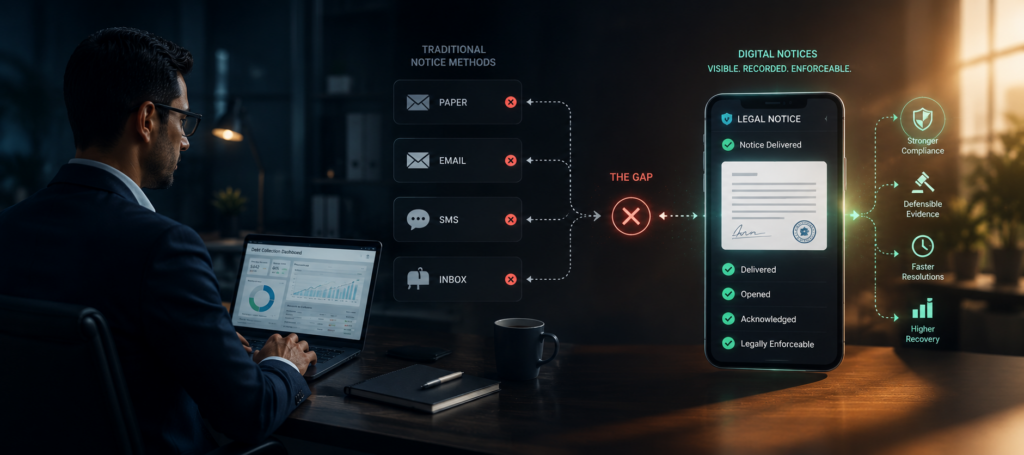
Debt Collection in Banking: Why Digital Notices Are Becoming Critical Debt collection is moving towards digital. Legal notices are not. Legal Notices, Digitally Delivered Escalation With Proof Author Ekta Singh Published on July 15, 2026 Banks are digitising borrower engagement, collection journeys, repayment nudges, and recovery workflows. But when an overdue account reaches the legal stage, many lenders still depend on paper notices, emails, SMS, or inbox-based channels. These channels may confirm that a notice was dispatched or delivered, but they do not guarantee 100% right-party contact, borrower visibility, or acknowledgement. And that is where the gap begins. Because at the legal escalation stage, sending a notice is not enough. Banks need to know that the notice reached the borrower, was opened, was acknowledged, and can be defended if questioned later. This is why digital notices are becoming critical in debt collection. Not as another communication channel, but as a stronger way to make legal notice delivery visible, recorded, and enforceable within the recovery journey. The Legal Notice Gap in Digital Debt Collection When defaults rise and more accounts move into escalation, the notice process becomes a direct part of recovery performance. But paper notices cost more, take longer, and create repeated operational effort. Email and inbox-based notices may be easier to send, but they do not always confirm borrower visibility. Messaging channels can be ignored, filtered, or treated as routine communication. None of this works well when the legal system needs proof. If the borrower does not see the notice in time, the response is delayed. If there is no acknowledgement, escalation becomes harder to defend. If the process depends on manual follow-ups, cost rises while certainty remains low. This directly affects recovery outcomes. At this stage, the concern is no longer just borrower outreach. It is whether the bank can move the case forward with enough visibility, evidence, and control. TruNotice by TrueDigi: Digital Legal Notices Built for Debt Collection TruNotice by TrueDigi addresses the core limitations of traditional legal notice delivery: uncertain reach, weak traceability, high cost, and low efficiency. It is a secure, bank-branded digital legal notice solution that delivers notices directly to the borrower’s active device. The notice is designed to be clear, visible, and action-led, with a contextual CTA that helps borrowers understand the next step immediately. This shifts legal notice delivery from an uncertain communication attempt to a digitally controlled escalation workflow. TruNotice delivers: 01 60% Increase in Recovery Rate: Borrowers responded faster when notices were delivered clearly and directly on-device. 02 Around 80% Lower Cost: Digital legal notice delivery reduced printing, courier, postage, and repeat-attempt costs. 03 100% Read Receipts: Every opened digital legal notice generated time-stamped proof that the borrower saw it. 04 100% Acknowledgement: Borrower acknowledgement created a stronger record for internal review, escalation, and next action. 05 2.4X Increase in Verified Delivery Rate: More notices successfully reached active borrower devices compared to paper and inbox-based channels. For banks building stronger digital debt collection solutions, TruNotice turns legal notice delivery from a slow, uncertain process into a branded, measurable, and defensible escalation workflow. [Also Read: The Future of Digital Debt Recovery in 2026] Smart pick for you… All Posts July 27, 2026 Right Party Contact (RPC): Higher Collections Start With the Right Customer July 15, 2026 Debt Collection in Banking: Why Digital Notices Are Becoming Critical June 26, 2026 Omnichannel Marketing Challenges and Solutions for Banks Follow Us On LinkedIn Building a Stronger Digital Strategy in Debt Collection with TrueDigi TruNotice works as a user-trusted escalation layer within TrueDigi’s larger direct-to-device debt collection platform. Before an account reaches legal escalation, TrueDigi helps banks engage borrowers through direct-to-device reminders, alerts, TruCall, TruPromise, TruTrace, and other capabilities. TruCall supports branded voice communication directly on the borrower’s device. TruPromise enables digital promise-to-pay journeys. TruTrace strengthens reachability through contact and location intelligence. Together, these tools help banks act earlier, before a case reaches the formal legal stage. When the borrower still does not respond, TruNotice brings the legal notice layer into the same digital strategy in debt collection, making escalation structured, recorded, and action-led. This is how TrueDigi’s digital debt collection solutions help banks move from fragmented outreach to a connected recovery journey: engage early, ease the repayment process, strengthen borrower visibility, and escalate with proof when required. Conclusion For banks, the real question is no longer whether debt collection should become digital. That shift has already begun. The question is whether every stage of the recovery journey is digital enough to support faster decisions, stronger records, and better outcomes. Legal notice delivery is one of the most critical stages in that journey because it sits at the point where delay becomes expensive, and uncertainty becomes risky. Bringing this stage into a controlled digital workflow helps banks strengthen not just escalations, but the overall quality of their digital strategy in debt collection. That is the direction recovery teams need to move toward: fewer gaps, clearer action, and stronger control across the full debt collection lifecycle. About TrueDigi TrueDigi is Datacultr’s AI-powered, user-trusted, direct to device customer engagement and debt recovery platform for banks and lenders. Embedded within the bank’s mobile app, it enables end-to-end journeys across collections and customer lifecycle use cases with 100% contactability, actionability, and real-time measurability. Make legal notice delivery a smarter part of your digital debt collection strategy. Book a Demo People also ask Still have questions? Can’t find answers to your questions? Contact Us Does TruNotice guarantee right-party contact for digital legal notices? TrueDigi’s TruNotice delivers digital legal notices directly to the borrower’s active device, reducing dependency on paper addresses, inboxes, or phone-number-based channels. This helps banks achieve 100% right-party contact, visibility, and acknowledgement at the escalation stage. How does TruNotice make debt collection escalation more defensible? TruNotice gives banks the audit layer that traditional notice delivery lacks. Every opened notice is recorded with read receipt, acknowledgement, and time-stamped proof, helping collections, risk, and legal teams move escalation forward with greater confidence. How does TrueDigi strengthen digital debt
Collections 2026: The Five Shifts Reshaping Recovery

Collections 2026: The Five Shifts Reshaping Recovery Collections 2026: The Five Shifts Reshaping Recovery Compliance Authentication Intelligence Digitalisation Control Author Ekta SinghPublished on December 28, 2025 Global collections is entering a period of unmistakable structural change. Defaults are rising across lending categories. NPLs are climbing in markets that have been stable for a decade. Cost-to-collect continues to increase despite years of digital transformation. And regulatory oversight is now shaping not just outreach rules, but the very architecture of internal operations. At the same time, customer behaviour has shifted sharply. Borrowers — especially younger cohorts — prefer digital, avoid human interaction, distrust unfamiliar outreach channels, and expect resolution to be instant and in-app. Across the board, collections leaders are reaching the same conclusion: The operating models that delivered results over the past decade will not survive the next two years. This blog distills the key themes for a successful collection strategy in 2026 — outlining the trends that will reshape how institutions think about engagement, compliance, and recovery. The Global Pressure Points: Where the System Is Straining Defaults Are Rising Defaults rose across lending categories as inflation, higher interest rates, and consumer leverage converged. In Europe, household delinquency climbed 11%; in APAC, credit card slippage rose 9%; and in the GCC, retail overdues increased 6–8%. Even markets once considered resilient saw cracks form in early-bucket performance. NPLs Are Increasing After a Decade of Stability Unsecured retail portfolios started showing early signs of stress with NPLs beginning to rise after nearly a decade of stability. Eurozone consumer NPLs moved from 1.9% to 2.4%; India’s early buckets grew 17% YoY; and digital loan NPLs across Africa now range between 10–20%, depending on the segment. Cost-to-Collect Keeps Climbing Operational inefficiencies are becoming impossible to ignore. Call centre costs have risen 12–18%, RPC rates remain stuck at 25–35%, skip-tracing is up 15–20%, and agent productivity has dropped by 10–25%. Institutions are spending more while reaching fewer customers — a model that no longer scales. Regulatory Pressure Is Intensifying Regulators are rewriting engagement rules across markets. Since 2022, over 60 regulatory updates have been made in USA market alone. GDPR penalties are up 40%, and more than 20 markets now enforce frequency caps and restrictions on SMS and phone outreach. Collections is shifting from effort-driven to evidence-driven, with compliance now defining how engagement must operate. Customer Behaviour Has Permanently Shifted Borrowers haven’t disengaged from repayment; they’ve disengaged from untrusted channels. Today, 60–70% prefer digital self-resolution, 80% ignore unknown calls, 50–70% of SMS is flagged as spam, and financial services email open rates sit at just 20–25%. Customers expect clarity, immediacy, and security. They only respond when engagement happens through trusted, authenticated spaces. Smart pick for you… All Posts July 27, 2026 Right Party Contact (RPC): Higher Collections Start With the Right Customer July 15, 2026 Debt Collection in Banking: Why Digital Notices Are Becoming Critical June 26, 2026 Omnichannel Marketing Challenges and Solutions for Banks Follow Us On LinkedIn The implication is clear: Economics, expectations, and regulation have fundamentally changed the role of collections. The Five Trends Defining Collections in 2026 Trend 1: Compliance – The New Operating Architecture Regulation is no longer simply a framework; it is reshaping how institutions must design engagement from the ground up. Since 2022, countless regulatory changes globally have affected outreach frequency, consent requirements, disclosure standards, and conduct guidelines. GDPR penalties alone are up 40% YoY. 1 Proof of consent, delivery, and read 2 Digital audit trails 3 Controlled escalation paths 4 Measurable frequency governance Institutions can no longer afford “high-volume, high-frequency” operations. Instead, they must shift to audit-ready engagement, where every touchpoint is traceable, compliant, and defensible 2026 reality: Compliance = Non-negotiable Strategy Trend 2: Authentication – Trusted Channels & Self- Service Options Borrowers want digital journeys; but only when they are trusted and actionable. The trust crisis in outreach channels is real: 1 80% of consumers decline unknown calls 2 SMS delivery increasingly unreliable 3 Email ignored unless expected 4 Links distrusted due to fraud So customers prefer self-resolution, but only when it happens inside trusted spaces — the bank’s app, authenticated environment, or known digital touchpoint. Institutions can no longer push customers across fragmented channels. Resolution must move inside existing, trusted ecosystems. 2026 reality: Customer Expectations = Trusted, Self-Serve Channels Trend 3: Intelligence – AI in Collections Replaces Traditional Bucket Sequencing Traditional workflows (“Day 3 → SMS”, “Day 7 → call”) were optimised for operational convenience, not borrower reality. AI in collections now allows institutions to orchestrate engagement based on: 1 Probability of repayment 2 Behavioural triggers 3 Risk sensitivity 4 Best timing 5 And the most effective touchpoint. When delinquencies rise, and contactability falls, precision becomes more valuable than frequency. AI in collections reduces attempts, improves outcomes, and meaningfully reduces cost-to-collect 2026 reality: Traditional Collection Buckets to Intelligent Behavioural Segments Trend 4: Digitalisation – Digital Debt Collection Evolves Into a CX Discipline Borrower expectations have shifted. They want clarity, dignity, and seamless digital resolution — not transitions across channels, long explanations, or opaque next steps. This shift has operational implications: Collections is no longer perceived as a back-office, corrective function. It directly influences renewal behaviour, brand trust, regulatory exposure, and complaints. In several markets, regulators now explicitly reference “borrower dignity” as part of compliance expectations. This reframes collections as part of the customer journey, not an escalation outside it. 2026 reality: Empathetic Collections = Integral to the customer journey. Trend 5: Control – Institutions To Bring Engagement Back Inside Their Walls For years, recovery operations spread across third-party agencies, call centres, outsourced delivery providers, dialer vendors, SMS providers, and external tech stacks. This model is now showing its limits. Rising costs, data leakage risks, and audit requirements are accelerating a shift back toward internally controlled engagement. Institutions are increasingly designing workflows where: 1 Resolution happens inside their own app 2 Data doesn’t leave their ecosystem 3 Compliance is built into the interaction layer 4 Customer journeys are owned end-to-end This internalisation is not just about security. It is about predictability, efficiency, and control — all essential in an
The Future of Digital Debt Recovery in 2026

The Future of Digital Debt Recovery in 2026 From Automation to Direct-to-Device Resolution The Future of Digital Debt Recovery in 2026 From Automation to Direct-to-Device Resolution Powered by TrueDigi E.D.G.E. Author Ekta Singh Published on December 15, 2025 The 2026 Challenge for Digital Debt Recovery As debt portfolios grow in size and complexity, consumer expectations are shifting faster than traditional collection systems can keep up. Credit issuers, collection agencies, and law firms are under unprecedented pressure to modernize their approach. Today’s borrowers demand faster, more secure, and empathetic interactions, while compliance requirements continue to evolve. Even digital debt recovery software, which automates workflows, segments accounts, and provides real-time analytics, is reaching its limits. When messages go unanswered, calls are blocked, and emails are lost in crowded inboxes, efficiency stagnates. In 2026, success will depend not just on automation but on intelligent, adaptable, and direct-to-device EDGE engagement. Why Traditional and Advanced Systems Are Failing Traditional debt collection relies heavily on field agents, an expensive, slow, and error-prone process. Modern “advanced software” improves efficiency with automation, multi-channel communication, and predictive analytics, but several key challenges remain: Incorrect or outdated contact information means up to 70% of customers are unreachable. Communication overload: messages are lost in crowded inboxes, marketing notifications, and spam filters. Trust deficit: unknown numbers are ignored, and new OS updates block unknown calls. Limited insight into real-time customer intent, leaving collection teams reactive rather than proactive. Even high-tech platforms often stop at digitizing processes; they don’t solve the fundamental problem: how to reliably reach the customer and engage meaningfully, at scale. The Need for a Radical Shift Small improvements to outdated methods are no longer enough. The industry requires: EDGE* Engagement that doesn’t rely on email, outdated numbers, or physical mail, but reaches right to the customer’s mobile screens at their preferred time and in their preferred language Consent-driven, secure communication that builds trust rather than friction. Measurable, actionable interactions that allow operations teams to understand and act on every customer response. This is the gap that TrueDigi fills: moving beyond traditional automation to a proactive, AI-powered, customer-aware solution. Enter TrueDigi: Reinventing Customer Engagement TrueDigi, a Datacultr platform, is a next-generation platform that transforms customer engagement and specifically uses cases like debt recovery into a customer experience. It combines AI, behavioral insights, and guided workflows to deliver: 100% right-party contact and higher actionability Lower cost-to-collect across portfolios Smartchannel, consent-aware journeys with full audit trails All built for banks, fintechs, telecom service providers, and utility service providers, TrueDigi aligns with GDPR/SOC 2 standards, offers API-first integration, and scales effortlessly. *Powered by the E.D.G.E. Framework At the heart of TrueDigi is the E.D.G.E. framework: Smart pick for you… All Posts July 27, 2026 Right Party Contact (RPC): Higher Collections Start With the Right Customer July 15, 2026 Debt Collection in Banking: Why Digital Notices Are Becoming Critical June 26, 2026 Omnichannel Marketing Challenges and Solutions for Banks Follow Us On LinkedIn E Efficient Reach Device-level contactability ensures reach where omnichannel ‘digital’ mediums like SMS, Email and Calls fail. D Data Security End-to-end encryption, global compliance, GDPR/SOC 2–aligned. Secure servers with full role-based controls. G Guided Engagement AI-powered orchestration for highly impactful marketing & collection journeys for the complete lifecycle. E Elevated Results Deliver high-impact outcomes with real-time analytics, audit-ready reports, and device-level measurability. Every interaction is trackable, actionable, and secure, ensuring that engagement translates directly into measurable outcomes. The 100% Club: Redefining Recovery Standards TrueDigi introduces the 100% Club: a new standard for collection efficiency. 100% Contactability – Reach customers reliably, regardless of outdated numbers. Actionability – Every communication prompts user action. Safety – Fully compliant, consent-driven, and secure. Measurability – Complete analytics to track performance and outcomes. This sets a new benchmark for the industry: no compromises, no guesswork, and no reliance on outdated methods. How TrueDigi Modernizes Every Stage of Recovery 1 Automation that Works 1 Automation that Works AI handles routine tasks: reminders, escalations, follow-ups, and more. Teams focus on high-value cases while the system maintains consistent, timely communication. 2 Smart-Channel, Device-Centric Engagement 2 Smart-Channel, Device-Centric Engagement Reach customers where they are: directly on their devices through secure, consented channels that they prefer, whether voice, Text, Video, or banners. No missed messages, no ignored emails. 3 Real-Time Analytics & Insights 3 Real-Time Analytics & Insights Dashboards track engagement, customer behavior, and response patterns. Decisions are informed, proactive, and backed by real data. 4 Seamless Integration 4 Seamless Integration TrueDigi works alongside existing CRMs, ERPs, and payment systems, ensuring your workflow remains unified and error-free. 5 Customer-Centric Experience 5 Customer-Centric Experience Borrowers get clear, respectful, and actionable communication. Payment extensions, reminders, and guidance are delivered empathetically, enhancing trust and satisfaction. Why TrueDigi is the Future of Debt Recovery Modern debt recovery is no longer just about collecting; it’s about engaging intelligently, securely, and humanely. TrueDigi empowers respective operations teams to: Scale operations without adding headcount Improve recovery rates while reducing operational costs Maintain compliance with evolving regulations Preserve and strengthen customer relationships The platform represents a bold shift from reactive collections to predictive, customer-aware, customer-first recovery. Move Beyond “Advanced Software” Advanced collection software was a step forward. TrueDigi is the leap. By combining AI in debt recovery, direct-to-device communication, and the E.D.G.E. framework, TrueDigi ensures every interaction counts, every message is heard, and every recovery is measurable. The future of digital debt recovery is here. Are you ready to join the 100% Club. About TrueDigi TrueDigi is Datacultr’s AI-powered, direct to device customer engagement and debt recovery platform for banks and lenders. Embedded within the bank’s mobile app, it enables end-to-end journeys across collections and customer lifecycle use cases with 100% contactability, actionability, and real-time measurability. Experience AI-powered, direct-to-device collections that put efficiency and empathy first. Book a Demo Frequently Asked Questions Still have questions? Can’t find answers to your questions? Contact Us How does TrueDigi enhance the digital debt recovery process? TrueDigi redefines digital debt recovery by integrating AI, behavioral insights, and device awareness into every stage of engagement. It helps lenders connect directly with borrowers’ devices, automate responses,
Digital Debt Collection in 2025: Why Outdated Collections Are No Longer an Option

Home Why Are Lenders Still Settling for Outdated Collections? Don’t settle for 30% efficiency rates Delivery ≠ action Digital Debt Collection in 2025: Why Outdated Collections Are No Longer an Option Don’t settle for 30% efficiency rates Delivery ≠ action Author Ekta Singh Published on October 27, 2025 “Call-and-collect” is supremely inefficient, yet many lenders still rely on it instead of embracing digital debt collection. The global debt collection services market is expected to reach $38.61 USD billion by 2032. The mainstay of the services industry continues to be “call-and-collect”, which delivers success rates of only 20–30%, meaning only $20–30 is recovered for every $100 overdue. On top of that: 70–80% of calls go unanswered Almost half of operational budgets are spent on manual collections Repeated, irrelevant outreach frustrates borrowers and drives complaints 70% of borrowers change their numbers after taking loans, leaving traditional calls largely ineffective. Month after month, the industry celebrates hitting minimal baselines, but that’s just mediocrity. The better way? TrueDigi’s fully digital debt collection platform that helps you recover more, reduce costs, and rebuild borrower trust, driven by data-first workflows and AI-enabled insights. Every missed call, outdated number, or ignored SMS is lost money. Borrowers have moved on, regulators are demanding better practices, and digital-first lenders are already proving that digital debt collection, enabled by AI, outperforms legacy models by a wide margin. It’s time to stop accepting inferior results and demand more. Smart pick for you… All Posts July 27, 2026 Right Party Contact (RPC): Higher Collections Start With the Right Customer Follow Us On LinkedIn Truly Digital Debt Collection Strategies in 2025 TrueDigi is leading this shift with a fully digital, integrated collections and engagement platform, built for banks, lenders, and fintechs ready to leave behind outdated methods and adopt digital debt collection that actually works. We’re not talking about tweaks to call centers. We mean a fundamental transformation, combining predictive analytics, personalized borrower journeys, and consent-led communication, underpinned by data-driven workflows and AI-enabled analytics. Lenders that embrace this are seeing: 25–40% higher recovery rates 90% upto lower cost per contact 100% borrower trust and compliance 82% increase in on-time payments Intelligent . Predective . Measurable Next-Gen Strategies Driving Smarter Collections Effective Borrower Interactions Reminders, nudges, and contextual outreach drive better repayment than endless phone calls. Using conversational AI in debt collection, TrueDigi ensures every interaction is timely, relevant, and actionable, turning engagement into measurable recoveries. Unified Platform, No Silos Most omni-channel strategies rely on multiple platforms, each managing a different channel: calls, SMS, email, or app notifications. This creates inefficiencies and bombards borrowers with repeated, irrelevant messages. TrueDigi consolidates customer engagement into a single intelligent platform, showing lenders how to improve debt collection efficiently. Predictive Analytics & Personalization Don’t wait for defaults. Predictive analytics, powered by AI in debt collection, forecast defaults before they happen and adjust outreach for maximum impact, ensuring borrowers receive human-like, personalized interactions while lenders reduce NPAs and increase pay-through. Smart Segmentation & Orchestration Stop blanketing borrowers with the same script. TrueDigi segments borrowers and automates next steps using data-driven rules and AI-enabled pattern analysis, cutting manual workloads while boosting precision. Efficiency Without Trust is Useless Aggressive doesn’t mean reckless. Digital debt collection in 2025 must also be borrower-centric and trust-driven. Borrowers respond when they trust the channel. That means: Consent-driven engagement: No spam, no guesswork. Just verified, opted-in communication. Personalized, relevant outreach: TrueDigi uses data and AI-enabled signals to select the right tone, language, and timing. Long-term trust: Clear, empathetic messaging builds repayment and loyalty. The Future is Already Here The future of collections is smarter, faster, and more human, combining digital debt collection practices with AI as an enabler. With TrueDigi, lenders finally get: 100% contactability through direct-to-device communication Data-driven optimization of every borrower journey Recovery rates that make legacy “call-and-collect” look like a relic So ask yourself: why settle for outdated, inefficient collections when outcome-driven, digitally enabled strategies already outperform legacy methods? With results like 4X higher collection efficiency and 70% lower costs, the numbers speak for themselves. It’s time to stop accepting mediocre results. It’s time to demand efficiency, trust, and growth. The future of debt collection isn’t coming; it’s here. TrueDigi delivers it through data-driven workflows and AI-enabled capabilities. Source: https://www.marketresearchfuture.com/reports/debt-collection-services-market-24376 About TrueDigi TrueDigi is Datacultr’s AI-powered, direct-to-device customer engagement and debt recovery platform for banks and lenders. Embedded within the bank’s mobile app, it enables end-to-end journeys across collections and customer lifecycle use cases with 100% contactability, actionability, and real-time measurability. Frequently Asked Questions Still have questions? Can’t find answers to your questions? Contact Us Why should lenders adopt digital debt collection? Digital-first platforms like TrueDigi move beyond traditional call-and-collect by combining borrower-friendly engagement with AI-enabled insights. This helps lenders improve repayment outcomes, reduce risk, and strengthen borrower trust. What are the benefits of AI in digital debt collection? With TrueDigi, lenders benefit from higher recovery rates, lower operational costs, and better compliance. By using AI as an enabler, the platform ensures communication is timely, transparent, and personalized, building stronger borrower relationships. Can digital collections improve borrower engagement? Yes. TrueDigi leverages AI to predict borrower behavior, tailor communication, and optimize reminder timing. This reduces friction, increases responsiveness, and turns repayment into a smoother, more predictable experience. How is AI used in banking collections? The intersection of AI and banking extends into collections, where it enables smarter outreach, dynamic segmentation, and predictive nudges. TrueDigi builds on these capabilities while keeping borrowers at the center, ensuring technology is an enabler of trust, not just automation. Digital-first platforms like TrueDigi move beyond traditional call-and-collect by combining borrower-friendly engagement with AI-enabled insights. This helps lenders improve repayment outcomes, reduce risk, and strengthen borrower trust. With TrueDigi, lenders benefit from higher recovery rates, lower operational costs, and better compliance. By using AI as an enabler, the platform ensures communication is timely, transparent, and personalized, building stronger borrower relationships. Yes. TrueDigi leverages AI to predict borrower behavior, tailor communication, and optimize reminder timing. This reduces friction, increases responsiveness, and